



Expert Tennis Elbow Treatment by a Trusted Surgeon in Nebraska
At Nebraska Hand & Shoulder Institute, we provide advanced, evidence-based care for patients struggling with tennis elbow, a common cause of persistent pain on the outside of the elbow. If gripping objects, lifting, or even light touch triggers sharp discomfort, you may benefit from an expert evaluation by Dr. Dolf Ichtertz, a board-certified tennis elbow surgeon with decades of experience treating elbow conditions.
Dr. Ichtertz specializes in the percutaneous lateral elbow tenotomy, a proven minimally invasive tennis elbow treatment that promotes natural healing, avoids large incisions, and helps patients recover faster without visible scarring.
With more than 250 successful tennis elbow procedures, our team focuses on achieving long-lasting pain relief and restoring full arm strength and motion—so you can get back to work, sports, and daily activities quickly and confidently.
Schedule your consultation today to learn more about the best surgical and non-surgical options for tennis elbow treatment in Nebraska.
Understanding Tennis Elbow (Lateral Epicondylitis)
Tennis elbow, medically known as lateral epicondylitis, is one of the most common causes of pain on the outer part of the elbow. It occurs when the tendons that attach to the forearm muscles become irritated or degenerated, leading to soreness, stiffness, and reduced grip strength. Although it often affects tennis players, this overuse injury can develop in anyone who performs repetitive hand or wrist motions.
At Nebraska Hand & Shoulder Institute, our team provides advanced, evidence-based tennis elbow treatment options that target the root cause and not just the symptoms, helping patients regain strength, flexibility, and lasting relief from chronic elbow discomfort.
Symptoms of Tennis Elbow
The most common tennis elbow symptoms include pain and tenderness on the outer side of the elbow, often at the bony bump where the tendons attach. This discomfort may spread down the forearm or radiate toward the shoulder, making simple tasks painful, like lifting a cup or shaking hands.
Many patients notice that pain increases when extending the wrist, gripping, or lifting objects with the palm facing downward. Over time, weak grip strength and stiffness in the forearm can also develop. Resting the arm and avoiding repetitive movements can help reduce irritation until proper tennis elbow treatment is started.
Diagnosis of Tennis Elbow
Diagnosing tennis elbow begins with a careful physical examination of the elbow, wrist, and forearm. During your visit at Nebraska Hand & Shoulder Institute, Dr. Ichtertz evaluates tenderness over the outer bony area of the elbow and tests for pain with resisted wrist or forearm movements to confirm whether the discomfort is due to lateral epicondylitis or another condition such as radial tunnel syndrome.
Imaging tests like X-rays are typically normal and not required for most patients. Advanced scans such as MRI or CT are reserved for rare cases when symptoms suggest another underlying issue. Accurate diagnosis is crucial, as other conditions, such as fibromyalgia, can mimic tennis elbow symptoms and delay proper treatment.
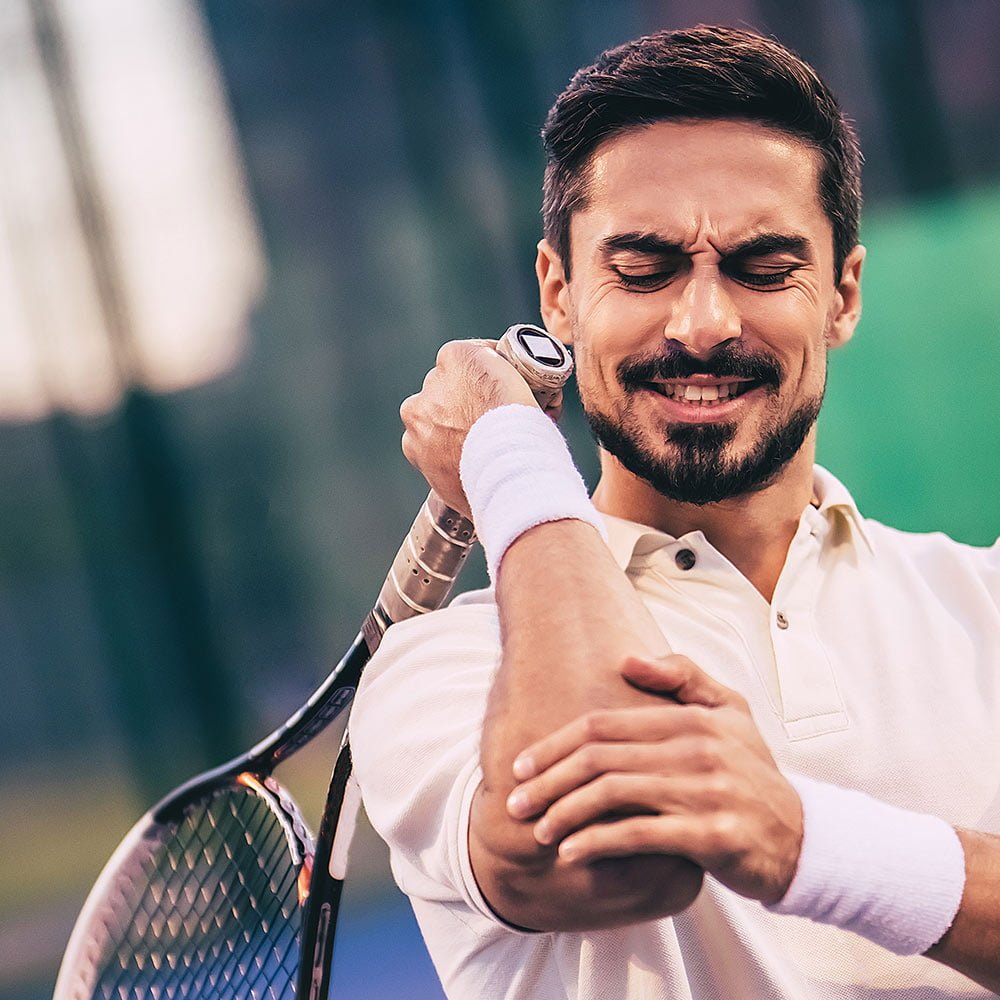
Causes of Tennis Elbow
The main cause of tennis elbow (or lateral epicondylitis) is gradual wear and tear of the extensor tendons that attach to the outer elbow. Over time, these tendons can weaken from repeated gripping or lifting motions, but the condition can also occur in people who don’t play sports or perform heavy physical work. In fact, many patients develop tennis elbow simply due to age-related tendon degeneration, not overuse alone.
Studies and tissue evaluations performed by Dr. Ichtertz confirm that tennis elbow is primarily a degenerative rather than inflammatory condition. This means that the pain comes from microscopic tendon damage (not swelling) making the term epicondylalgia (elbow pain) more accurate than epicondylitis (inflammation).
Some individuals may experience tennis elbow along with carpal tunnel or cubital tunnel syndrome because the radial nerve that supplies the outer elbow can also become irritated, causing overlapping symptoms.
Comorbidities (Other conditions occurring at the same time)
Many patients diagnosed with tennis elbow also experience carpal tunnel syndrome or cubital tunnel syndrome at the same time. These overlapping conditions often occur because the radial nerve, which supplies sensation to the outer elbow, may not function properly, contributing to pain, weakness, or persistent discomfort in the affected arm.
Research dating back to the 1950s, 1980s, and 2000s by surgeons Emmanuel Kaplan, Wittenberg, and Dellon demonstrated that denervation of the outer elbow can be an effective solution for chronic tennis elbow pain. This minimally invasive surgical approach provides reliable pain relief with faster recovery, minimal scarring, and lower cost compared to traditional open procedures.
Tennis Elbow Treatment Options
Non-Surgical Treatment Options
At Nebraska Hand & Shoulder Institute, we understand that tennis elbow pain can last for weeks or even months before improving. While there are many opinions about the most effective non-surgical tennis elbow treatment, our experience shows that excessive activity or repetitive exercises can sometimes worsen symptoms rather than relieve them.
For many patients, a cortisone injection provides some short-term relief by reducing local pain and irritation around the affected tendon. Although the exact mechanism isn’t fully understood, patients often experience improvement lasting weeks to months and sometimes complete, lasting relief.
A tennis elbow brace or strap may also help decrease strain on the tendon during activity. While these methods can ease discomfort, they are typically temporary solutions and do not address the underlying tendon degeneration that causes lateral epicondylitis.
Surgical Treatment for Tennis Elbow
When non-surgical methods fail to provide lasting relief, Dr. Dolf Ichtertz, an experienced tennis elbow surgeon, may recommend a percutaneous lateral elbow tenotomy: a minimally invasive surgical procedure proven to relieve chronic lateral epicondylitis pain. First reported in the 1980s and refined over decades, this approach remains one of the most effective and cost-efficient tennis elbow treatments available today.
The procedure is performed through a small puncture rather than a large incision, resulting in no visible scar, minimal discomfort, and little to no downtime from work. Most patients reach maximum medical improvement within three to four months.
Other surgical techniques, such as the Nirschl procedure, arthroscopic extensor origin debridement, and the Tenex system, are available but tend to carry greater risks, higher costs, and longer recovery times. The Tenex method, in particular, remains investigational and the Nirschl procedure leaves a substantial scar, along with the inability to offer the same consistent results as the percutaneous tenotomy technique used at our clinic.
Results and Recovery After Tennis Elbow Treatment
Outcomes from tennis elbow treatment can vary based on factors like age, occupation, and overall health. However, both our non-surgical and surgical tennis elbow procedures consistently achieve excellent success rates.
In particular, the percutaneous lateral elbow tenotomy (a minimally invasive technique) has delivered outstanding results for our patients. Research and in-practice data show that up to 90% of patients experience good to excellent outcomes. Within about three months, approximately 70% are pain-free, and another 20% reach maximum medical improvement (MMI) shortly after.
Many patients can return to work almost immediately with only minor restrictions, especially in workers’ compensation cases. By contrast, more invasive procedures such as arthroscopic ECRB debridement or open lateral epicondylectomy may involve longer recovery times, visible scarring, and higher costs due to extended downtime.
Our goal at Nebraska Hand & Shoulder Institute is to restore comfort, confidence, and functionality. That way you can get back to your normal routine quickly and safely.
Schedule Your Tennis Elbow Consultation Today
At Nebraska Hand & Shoulder Institute, our mission is to help every patient find lasting relief from tennis elbow pain through advanced, evidence-based care. Led by Dr. Dolf Ichtertz, an experienced tennis elbow surgeon, our team has successfully treated hundreds of patients using both non-surgical and minimally invasive techniques designed to restore strength, comfort, and function.
Don’t let chronic elbow pain limit your daily life. Schedule your consultation today to discuss your personalized tennis elbow treatment plan with Dr. Ichtertz and take the first step toward recovery.
Call now to request your appointment or contact us online to get started.
Baker, et al., Journal of Shoulder & Elbow Surgery, 2000.
Baumgard, S.H., Schwartz, D.R. "Percutaneous release of the epicondylar muscles for humeral epicondylitis." Am. J. Sports Med., 1982; 10:233-236.
Dunkow, P.D. et al. "Functional outcome was better after percutaneous surgery than after open formal release for tennis elbow." JBJS British, July 2004; 86:701-704.
Grundberg, A.B., Dobson, Jeanine F. "Percutaneous release of the common extensor origin for tennis elbow." Clinical Orthopaedics-Related Research, July 2000; 376:137-140.
Kaplan, E.B. "Treatment of tennis elbow (epicondylitis) by denervation." JBJS; Jan. 1959;41A:1.
King, et al., Journal of Hand Surgery, 2009.
Nirschel, R. P. and Kraushaar, B. S. “Tendinosis of the Elbow (Tennis Elbow)” JBJS; Feb 1999; 81-A, No. 2; 259-277.
Owens, et al., Arthroscopy, 2000.
Wilhelm, A. "Tennis elbow: treatment of resistant cases by denervation." Journal of Hand Surgery British, 1996; 21B:4:523-533.
Yerger, B., Turner, T. "Percutaneous extensor tenotomy for chronic tennis elbow: an office procedure." Orthopaedics, Oct. 1985; 8:10:1261-1263.
Yoon, et al., Arthroscopy, July 2015, Volume 31.